





How do I crate train my puppy?
 By Dr. Steve Pelton, DVM, a small-animal vet since 2000.
The short answer
- The crate is his own small bedroom, a safe cave. It's never a punishment.
- Make it good from day one: meals, treats and naps in the crate, door open at first, then short stretches with it closed.
- Keep daytime stretches short: about an hour at 8 to 10 weeks, building to a few hours as he grows. Never all day.
- Crying the first nights is normal. Crate by your bed, quiet potty trips, no party. It usually gets much better within a week or two.
Why a crate, even if you won't use one later
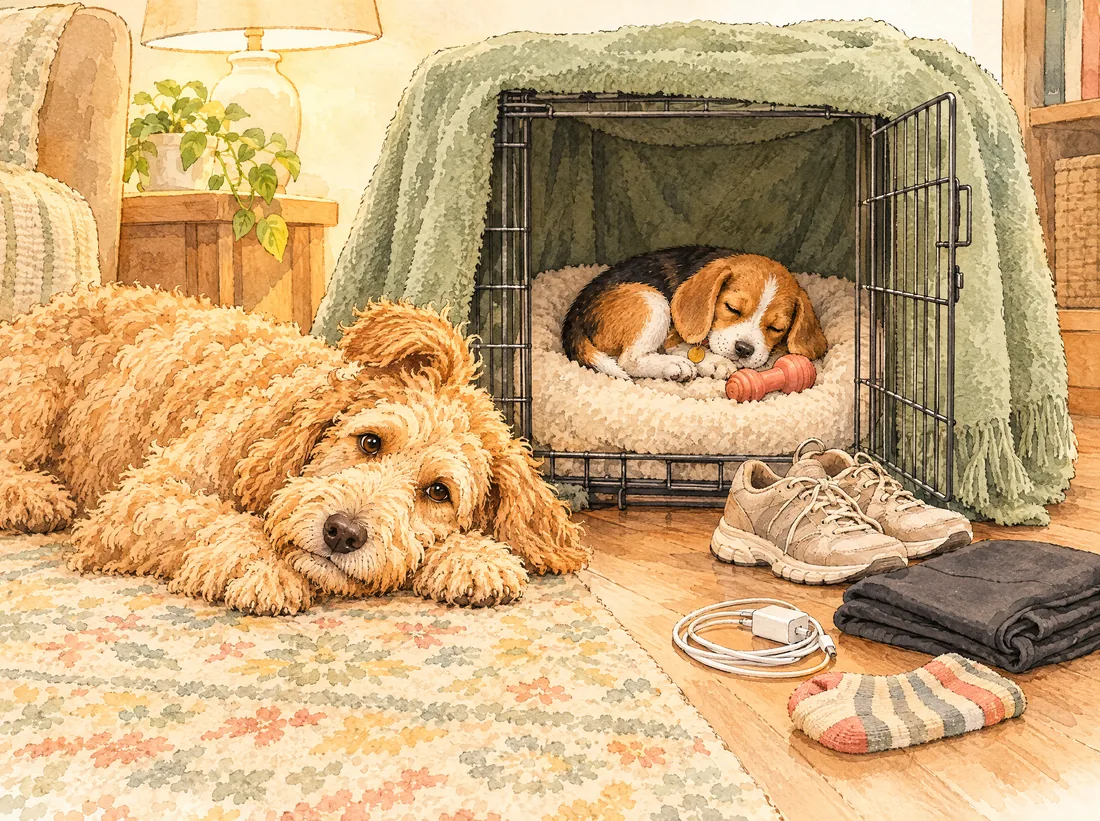
If the word "crate" makes you picture a cage, I get it. Picture a small, cozy bedroom instead. Most puppies like a snug, covered spot to sleep, the way a kid likes a blanket fort. Done right, it's where he goes on his own when he's tired, and where he feels safest when the house gets loud.
Plenty of people plan to give their dog the run of the house someday, and that's fine. I'd still crate train young. You can't watch a puppy every minute, and the crate keeps him out of trouble when you can't. It keeps your shoes, your remote and your favorite leggings in one piece. It also keeps him out of surgery: socks, underwear, toy pieces and cords are some of the things I see stuck inside puppies, and some of them only come out with an operation. Puppies of my own have chewed my shoes and the corner of a kitchen cabinet, so I know the drill.
Puppies also crave a routine. When the crate always means a nap and a chew, and the nap always ends with you, a 9-week-old who just left everything he knew has one less thing to worry about. And a crate-happy dog has an easier time later at the vet, the groomer, in the car, in a hotel room or in a storm evacuation.
Picking the crate and getting the size right
The right size
- Room to stand up, turn around and lie stretched out.
- Not so big that he can sleep at one end and pee at the other. Most puppies won't soil the spot where they sleep.
- Growing fast? Buy the size he'll need as an adult and use a divider panel, moving it back as he grows. One crate does the whole job.
Wire or plastic
Either works. Wire crates fold flat, often come with a divider and let you drape a blanket over the top. Plastic ones feel more like a den on their own and travel well. Pick whichever fits your house; how you use it matters far more than which kind it is.
Set it up like a den, and put it where you are
Make it cozy
- Soft bedding, plus a T-shirt you've worn so it smells like you.
- A blanket over the top and sides, front left open. Keep it where he can't pull it in and chew it.
- A safe chew toy that only lives in the crate.
- Harness off, and nothing on his collar that could snag on the wire.
- Shredding his bed? Take it out for a while and use a mat. Swallowed fabric is one of those surgery problems.
Where it goes
- At night, in your bedroom, right next to your bed. Hearing you breathe settles a lot of puppies.
- In the daytime, where the family is, so the crate never means being sent away. A second crate or a pen in the living room is handy.
- Moving it out later is optional. Once he's slept through quietly for a week or two, move it a little every few nights. Crying again? Go back a step.
The crate intro, step by step
Night is a hard time to learn about a crate, so start in the daytime, from the first day, while he's rested and you're not in a hurry. Move to the next step when he's relaxed at this one. Most puppies settle in within a week or two, and many start walking in on their own.
Step 1: Let him find it
Door open, a soft bed inside, a few treats tossed in. Let him wander in and out. No pressure to stay.
Step 2: Meals in the crate
Bowl at the back, door open. Every meal is a good thing that happens in there.
Step 3: Close it while he eats
Shut the door for a few seconds while he's busy with his bowl, and open it again before he's done. Then a little longer next time.
Step 4: You nearby, then the next room
A few minutes with you sitting right there. Then a few minutes with you in the next room, and back before he worries.
Step 5: Naps go in the crate
When he's yawning and wobbly, in he goes with a chew. Daytime naps are some of the best practice there is.
Step 6: Build up slowly
Stretch the alone time a little at a time, up to the limit for his age. A few short, happy sessions a day beat one long one.
The one rule I'd ask every family to agree on: open the door on a quiet moment.
If the door opens every time he barks, he learns that barking opens doors, and he gets louder. If it opens after a couple of seconds of quiet, he learns that calm opens doors. Two exceptions: if he might need to pee, take him out calmly right away, and if he's panicking, let him out and go back to much easier steps.
The Crate Clock
Daytime, door closed
About 1 hour
A limit, not a goal. Less is better, and toy breeds may need breaks sooner.
Overnight
In the crate by your bed, with 1 or 2 quiet potty trips.
Nights stretch longer because he's asleep and you're right there.
| Age | Longest daytime stretch |
|---|---|
| 8 to 10 weeks | About 1 hour |
| 10 to 14 weeks | About 1 to 3 hours |
| 15 to 16 weeks | About 3 to 4 hours |
| 4 to 6 months | About 4 hours |
| 6 months and up | About 5 or 6 hours at most |
You'll see a rule of thumb online: his age in months plus one, in hours. That's roughly how long a puppy can hold his bladder, which makes it a ceiling, not a target. For a closed crate in the daytime, I'd stay shorter, with the limits above.
A sample day at 8 to 10 weeks
Lots of sleep, small meals, and a potty trip after every nap, meal and play session. An example, not a rule.
- 6:30 a.m.Up and carried straight to his potty spot. Quiet praise when he goes.
- 6:45Breakfast in the crate, door open. Potty after.
- 7:00Play, cuddles, a minute of touching paws and ears.
- 7:45Potty, then a nap in the crate with a chew.
- 9:30Up, potty, play, potty. Then another nap.
- 12:00 p.m.Up, potty, lunch, potty.
- 1:00Alone practice: a few minutes in the crate while you're in the next room. Then a nap.
- 3:00Up, potty, play, two minutes of training.
- 5:30Up, potty, dinner, potty, family time.
- 7:00 p.m.One more nap. This is the one that heads off the evening biting.
- 9:45Last potty trip, calm and boring. Bed in the crate next to yours.
- OvernightOne or two quiet potty trips. Out, wait, praise, straight back.
Built around someone up at 6:30 and in bed around 10. Slide it to fit your house and keep the order.
General education, not veterinary advice. Your vet's plan for your puppy comes first.
When he cries in the crate at night
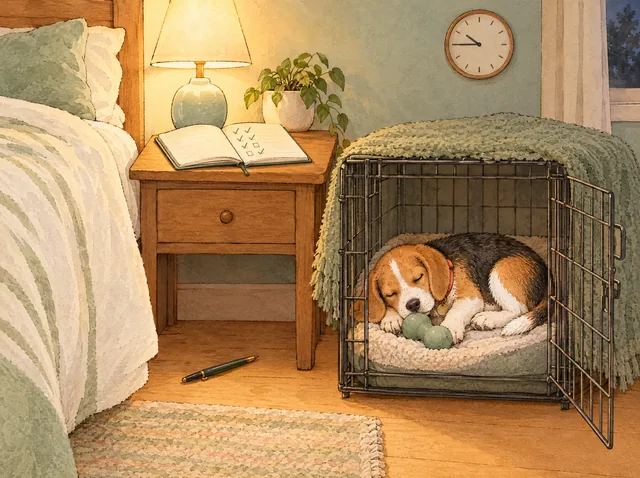
If you're reading this at 2 a.m. with a crying puppy next to the bed, you're doing fine, and so is he. He's lonely, in a new place, maybe cold or needing to pee, and he's never slept away from his littermates before. Crying is how a puppy calls the litter back. Here's the plan.
Before bed
Last play, then a calm last potty trip. Into the crate with a chew and a T-shirt that smells like you. Lights out, same order every night.
He was asleep, and now he's crying
Assume he needs to pee, especially under about 4 months. Carry him out, wait, praise him quietly, carry him straight back. No play, no lights if you can help it.
You just brought him back and he's protesting
Stay put. A calm word or your fingers through the side of the crate is fine, since he's right by your bed. Wait for a few seconds of quiet before you do anything else.
It keeps going
Check the simple things: is he cold, is his bedding wet, did he have an accident, is he tangled in something? Fix it quietly and go back to waiting for quiet.
Don't make it a party. Overnight trips are short, dark and boring: no play, no chatting, straight back to bed. And never punish the crying. Yelling, banging on the crate or a squirt of water only teaches a lonely puppy that nighttime is scary too.
What to expect, night by night
A common pattern, not a promise. Some puppies are faster, some take a little longer.
Nights 1 to 3
The hardest stretch. Crying in bursts is normal, plus one or two potty trips.
Nights 4 to 7
Shorter bouts. He settles faster after each trip.
Week 2
Most puppies are settling well. Young ones may still need a trip.
Still hard after 2 weeks?
Talk to your vet. Weeks of crying, or panic, deserve a closer look.
What not to do
Never as punishment
Not for chewing, not for an accident, not for the evening shark show. If bad things happen there, he'll fight going in.
Never all day
A crate is for naps, nights and the times you can't watch him. For a workday, a pen with the crate inside, door open, works better.
Don't force him in
No shoving, no dragging. Toss a treat in and let him choose to follow it.
No yelling, banging or water
It just teaches a lonely puppy that the crate is scary too. Reward-based methods only.
Don't open it mid-yell
Wait for a quiet moment, so he learns calm opens doors. The exceptions: he needs to pee, or he's panicking.
Harness off, kids out
Nothing on him that could snag on the wire. And kids never climb in or reach in. It's his room.
An older puppy or rescue who's never seen a crate
Go slow. Set the crate up in the living room with the door propped open, or take the door off for now. Put a soft bed and a treat inside and let her find it. Feed meals next to it, then just inside, then at the back. Don't close the door until she's walking in on her own and relaxing there. If a crate scares her, a gated room or a pen works just as well while she settles in.
When it's more than crate training
Most crate trouble is a puppy learning something new. A few signs mean something else is going on.
WATCH
Crying in bursts in the first week or two that settles once he's been out, he's warm and you're close by.
CALL TODAY
- Panic in the crate: drooling, frantic, biting at the bars, hurting himself trying to get out
- Weeks of crying, or panic every time you leave the room
- Crying plus vomiting, diarrhea, coughing, straining to pee or not eating
GO NOW
Crying and he's also weak, flat or has a swollen belly. Head to your vet or the nearest emergency clinic, and call on the way.
Panic isn't something to wait out. Let him out, go back to much shorter, easier steps, and talk to your vet. A reward-based trainer or a veterinary behaviorist can help a lot, and earlier is easier.
What to ask your vet
- Is his crying normal for his age, or should we look for a reason?
- How often should he go out overnight at his age and size?
- He's a toy breed. How long can he go between meals and potty trips?
- He panics in the crate. Can you point us to a reward-based trainer or a behavior vet?
- He's having surgery soon. How should we use the crate while he heals?
Questions I get every day
Is it cruel to crate a puppy?
Not when it's done kindly. A crate set up as a cozy, covered den, with good things happening in it and short daytime stretches, becomes the spot he picks on his own when he's tired. What makes it unkind is using it as a punishment or leaving him in it all day.
How long can a puppy stay in a crate?
In the daytime, about an hour at 8 to 10 weeks, about 1 to 3 hours at 10 to 14 weeks, 3 to 4 hours at 15 to 16 weeks, and about 4 hours from 4 to 6 months. These are limits, not goals. Overnight is different: he's asleep by your bed, and young puppies get one or two quiet potty trips.
Should I let my puppy cry it out in the crate?
Not if he might need to pee: a puppy who wakes up crying usually does, so take him out, calmly. If you've just brought him back and he's protesting, wait for a few seconds of quiet before you open the door or fuss. Never wait out panic, like drooling, frantic biting at the bars or hurting himself.
Where should the crate go?
Next to your bed at night at first, so he can hear and smell you. In the daytime, somewhere the family hangs out. Once he's slept through quietly for a week or two, you can move it a little at a time, or leave it in the bedroom for good. Lots of dogs sleep there for life.
Should I leave water in the crate?
For naps and overnight, most healthy puppies don't need a bowl in the crate, and it usually gets tipped over. Offer water often while he's awake. For longer stretches, use a pen with water in it. If he's a toy breed or has any health problem, ask your vet.
Do I have to crate train if I won't use a crate later?
I'd still do it. It keeps him safe when you can't watch him, it protects your shoes and clothes, and it keeps socks, underwear and cords out of his stomach. A crate-happy dog also has an easier time at the vet, the groomer, in the car and in a storm evacuation.
What size crate does my puppy need?
Big enough for him to stand up, turn around and lie stretched out, and no bigger. If he can sleep at one end and pee at the other, it's too big. If he's going to grow a lot, buy the crate he'll need as an adult and use a divider panel, moving it back as he grows.
Should I cover my puppy's crate?
Most puppies settle better with a blanket over the top and sides and the front left open. It makes the crate feel like a den, the way a kid likes a blanket fort. Keep the blanket where he can't pull it in and chew it, because swallowed fabric can mean surgery.
How do I stop my puppy crying in the crate at night?
Put the crate right next to your bed, do a calm last potty trip and keep the same bedtime routine every night. If he wakes up crying, assume he needs to pee: carry him out, praise him quietly and carry him straight back, with no play. If he's protesting right after you've brought him back, wait for a few seconds of quiet before you do anything. Most puppies are settling well within a week or two.
How long does crate training take?
Most puppies settle into the crate within a week or two, and many start walking in on their own. The first three nights are usually the hardest. Longer daytime stretches build slowly with his age, so keep up a few short, happy sessions a day. Weeks of crying, or any panic, is worth a call to your vet.
Can I crate my puppy while I'm at work?
Not all day. An 8- to 10-week-old can only manage about an hour alone, and even a 6-month-old tops out around 5 or 6 hours in a closed crate. For a workday, use a pen with the crate inside and the door open, plus water, a bed, chews and a potty patch at the far end. He still needs a midday visit, and puppies under about 4 months need a mid-morning and mid-afternoon visit too.
Why is my puppy peeing in his crate?
Usually the crate is too big, he's been in longer than he can hold it, or he went in without a potty trip first. Check that it's just big enough to stand, turn and stretch out, keep stretches within the limit for his age, and take him out right before he goes in. Clean the crate with an enzyme cleaner made for pet accidents, and never punish him for it. If he's peeing often, straining, or this started after he'd been doing well, call your vet today.
When can my puppy sleep out of the crate?
There's no set age. Wait until he's sleeping through quietly, reliably house trained and past chewing everything he can reach, which for a lot of dogs is somewhere after the teenage months. Try one night with the crate door open and the bedroom door closed, and go back a step if things get chewed or wet. Moving out is optional: lots of dogs keep the crate as their bed for life.
How do I crate train an older puppy or rescue dog?
Go slow. Set the crate up in the living room with the door propped open or off, put a soft bed and a treat inside, and let her find it. Feed her meals next to it, then just inside, then at the back, and don't close the door until she's walking in and relaxing on her own. If a crate scares her, a gated room or a pen works just as well while she settles in.
Where this comes from
- The Humane Society of the United States. Crate training your dog. (A safe place, never punishment; meals and treats in the crate; daytime limits by age; harness and collar off; a pen for longer absences.)
- ASPCA. Crate training, and house training your puppy. (Gradual introduction; potty trips after waking, eating and play; no punishment.)
- American Kennel Club (AKC). How to crate train your dog; how long a puppy can hold his bladder (age in months plus one, in hours, as a general guide); choosing a crate size and using a divider.
- American Veterinary Society of Animal Behavior (AVSAB). Humane Dog Training Position Statement. 2021. (Reward-based methods only.)
- American Animal Hospital Association (AAHA). Canine and Feline Behavior Management Guidelines. 2015. (Predictable routines, early alone-time practice, reward-based training.)
General education, not veterinary advice. Your vet's plan for your puppy comes first.