





How do I potty train my puppy?
 By Dr. Steve Pelton, DVM, a small-animal vet since 2000.
The short answer
- Routine wins. Take him out first thing in the morning, after every nap, meal, drink and play session, and right before bed.
- Same door, same spot, one cue word, and a small treat outside the second he finishes.
- In the daytime, about every 1 to 2 hours at 8 to 10 weeks, stretching to every 4 to 6 hours by 6 months.
- Accidents happen. Clean them with an enzyme cleaner made for pet accidents, and never punish or rub his nose in it.
- Peeing every few minutes, straining or accidents after he'd been doing well is a call to your vet today. Straining with nothing coming out: go now.
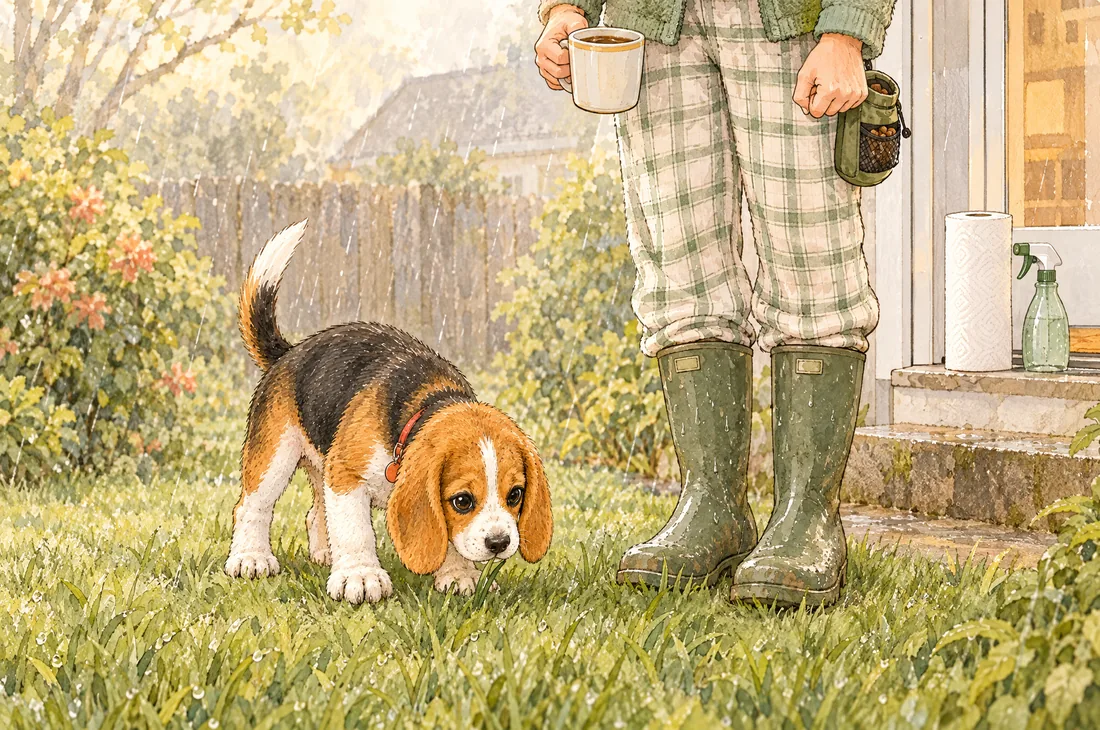
Frustrating at times, and it works
If you're on your third accident of the morning and wondering whether this puppy will ever get it, you're in good company. Potty training is frustrating at times. It was for me too. I've cleaned puppy pee and puppy poop off a bathroom floor, a rug and a bed. It wore me down, I held strong, and it worked. So don't give up. Just hold strong.
Here's the thing that makes it work: puppies crave routine. A puppy's body runs on a clock. A full stomach gets his gut moving, so he usually needs to poop soon after a meal, and a full bladder wakes him up. When meals, naps and potty trips happen at about the same times every day, his body settles into that rhythm, and you start to know when he needs to go before he does. Fewer guesses, fewer accidents.
The full training plan is a trainer's job. This is what gets most families through the first weeks, and it's the same thing I tell every client with a new puppy.
When to take him out
Two things decide it: the clock, and what he just did. These six times are on top of the clock below.
First thing in the morning
Before coffee, before shoes if you have to. Carry a young puppy so he doesn't stop in the hallway.
Right after he wakes up
From any nap, not just overnight. A full bladder is often what woke him.
Right after he eats or drinks
A full stomach gets his gut moving, so a poop often follows a meal.
During and after play
Play stirs everything up. Take a break mid-zoomies if it's been a while.
After a long chew
A good chew session counts as busy time too.
Right before bed
A calm, boring last trip, every night.
Watch for the signs. Sniffing the floor, circling, or suddenly wandering off to another room usually means he's about to go. Scoop him up and head out.
Write it down for a few days. When he pees, when he poops, when he eats. After three or four days you'll see his pattern, and you can set your schedule to him instead of to a chart. There's a printable potty log in the first-week plan.
The Potty Clock
Daytime, while he's awake
About every 1 to 2 hours
Also take him out: right after every nap, meal, drink and play session.
Overnight
1 or 2 trips.
Short, dark and boring: out, wait, quiet praise, straight back to bed.
- The most he can hold it, daytime
- About 3 hours. A ceiling, not a target.
- Closed crate in the daytime
- About 1 hour, from the Crate Clock.
| Age | Daytime, while awake | Overnight |
|---|---|---|
| 8 to 10 weeks | About every 1 to 2 hours | 1 or 2 trips |
| 10 to 12 weeks | About every 2 hours | 1 or 2 trips |
| 3 months | About every 2 to 3 hours | Often 1 trip |
| 4 months | About every 3 to 4 hours | Often none, and 1 is still normal |
| 5 months | About every 4 hours | Usually none |
| 6 months | About every 4 to 6 hours | Usually none |
| Grown dog | 3 to 5 times a day | None |
The rule of thumb most trainers and vet groups use: his age in months, plus one, is about the most hours he can hold it in the daytime while he's awake. That's a ceiling, not a target. In the first weeks you'll go out far more often than that, because of all the trips after naps, meals, drinks and play.
Toy breeds have smaller bladders and often need trips a little more often than the chart says, for a little longer.
General education, not veterinary advice. Your vet's plan for your puppy comes first.
The potty routine, step by step
Same steps, same spot, every time. It isn't exciting, and it works better than almost anything else I can tell you.
Step 1: Out the same door
Carry a young puppy, or clip on his leash, and head out the same door every time. Have the leash, shoes and keys ready before he wakes up.
Step 2: Straight to the same spot
Walk to his spot and stand there quietly for a few minutes. Let him sniff. The smell of last time tells him what this place is for.
Step 3: Say your word
As he starts to go, say one calm cue word, like "potty" or "go pee." Pick one and have the whole family use the same word.
Step 4: Praise and a treat, right there
The second he finishes, quiet praise and a small treat, outside. Not when you get back to the kitchen. That's how he learns what earned it.
Step 5: A little play, then back in
A minute of play or sniffing around, so going out isn't the end of the fun. Then back inside.
Step 6: Nothing? Try again soon
If nothing happens in a few minutes, bring him in, keep him in his crate or right next to you for 10 or 15 minutes, and try again.
Why the treat has to happen outside
A puppy connects a reward with whatever he did a second or two before it. A treat in his spot, the moment he finishes, says "that, right there." A treat back in the kitchen says "nice job walking through the door." Keep a few small treats in your pocket or by the door so you're never empty-handed.
Accidents happen
For weeks, and sometimes again later. His bladder is small and his control is still coming in. Every family hits a bad week. Here's what to do.
Catch him in the act?
Calmly scoop him up, take him outside to his spot, and praise him if he finishes there. No yelling. A quiet "oops" is plenty.
Found it later?
Just clean it up. He can't connect a puddle from ten minutes ago with anything you say now.
Clean it so it doesn't smell like a bathroom
Blot up what you can, then use an enzyme cleaner made for pet accidents. Regular household cleaners can leave enough smell behind that he'll go there again. Skip ammonia cleaners: to a dog they smell like pee.
Read it as a clue
Every accident tells you something: he needed to go sooner, or he had too much room without someone watching. Take him out sooner next time, and keep him in sight or in his crate or pen when you can't watch.
The one rule
Never punish an accident. Yelling, a swat or rubbing his nose in it doesn't teach him where to go. It teaches him to be afraid to pee in front of you, which makes him sneak off to go behind the couch, and it makes him nervous to go on the leash outside too.
Nights
- A calm last potty trip right before bed, every night, in the same order: last play, last potty, into the crate with a chew.
- Crate right next to your bed, so you hear him stir before he has to go.
- Young puppies need 1 or 2 overnight trips. He can usually hold it longer at night than in the daytime, because he's asleep, but not all night yet.
- Keep it boring. Carry him out, wait, praise him quietly, carry him straight back. No play, no chatting, as little light as you can manage.
- Should you set an alarm? For a young puppy, many owners set one for a single overnight trip, which can save the bedding. Once he's waking up dry most mornings, let him sleep and only take him out if he wakes and fusses.
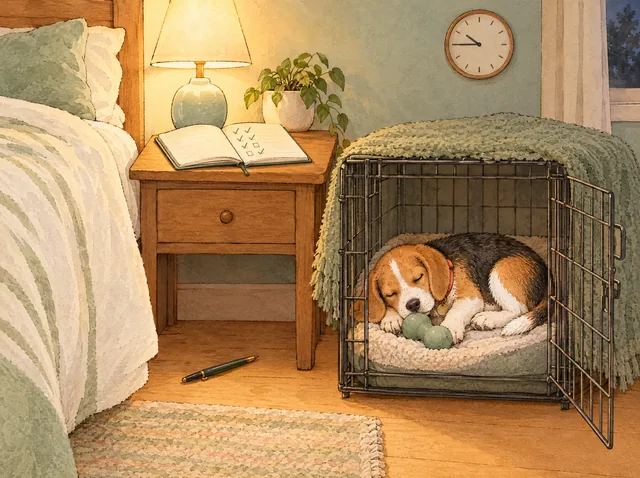
Crying in the crate at night? The night plan in the crate guide walks through it, step by step.
The crate and potty training work together
Most puppies don't want to soil the spot where they sleep, so a crate that's the right size helps him learn to hold it for short stretches. Right size means room to stand up, turn around and lie stretched out, and no more. If he can sleep at one end and pee at the other, it's too big; a divider panel fixes that while he grows.
Take him out right before he goes in and right when he comes out. Keep closed-crate time within the limit for his age, which is only about an hour at 8 to 10 weeks. And the crate is never a punishment for an accident. If bad things happen there, he'll fight going in.
For a workday, a pen with the crate inside and the door open, plus his bed, water, chew toys and a potty patch at the far end, gives him somewhere to go if he can't wait. That buys a little slack on his bladder. It doesn't buy any on loneliness or lunch, so the midday visit still matters. The crate training guide has the step-by-step intro, the limits by age and sample days.
Pee pads, patches and apartment life
Pads and indoor patches
- An indoor or balcony potty patch, or pads, is fine, especially early on, for overnight trips and on high floors.
- Keep it in one spot. Moving it around confuses him.
- When you start taking him outside instead, bring a used piece of the pad or patch along at first so the new spot smells right.
- Moving one step at a time works: one spot inside, then the real spot outside. It can take a little longer.
Stairs, elevators and no yard
- Leash, shoes and keys by the door before he wakes up. A puppy who just woke up won't wait while you look for keys.
- Carry a small puppy through hallways, stairwells and the elevator. He can't hold it that far yet.
- Pick a spot away from the shared dog-relief strip until your vet says his shots are far enough along. Here's why, and where he can go.
- Never leave him alone on a balcony. Small puppies can squeeze through railings.
Tank's BS-meter: "Pee pads ruin potty training forever." 7 out of 10.
The higher the number, the more nonsense. Lots of apartment puppies start on pads or a patch and learn to go outside just fine. "Forever" it isn't.
How long it takes, and the setbacks
Most puppies are fairly reliable somewhere around 4 to 6 months old, and some take longer. Toy breeds often need extra trips for a little longer. It isn't a straight line, either. A puppy who's been perfect for a week can have three accidents on Saturday, and that's normal.
Expect a slip or two when life changes:
- Travel or a new place. Keep the order of his day even if the clock is different, and take him out more often.
- A move, a new baby or a new job. Go back to the basics for a week or two: more potty trips, more naps, the same order every day.
- The teenage wobble. Somewhere around 6 months, a lot of puppies seem to forget the routine and have an accident for the first time in weeks. Go back to more frequent trips for a couple of weeks.
One exception to all of that: if accidents come back suddenly, or he's peeing much more than usual, check with your vet before you blame his age. A bladder infection can look a lot like a teenager. Otherwise, every family hits a bad week. Hold strong. Routine wins.
When it's not just training
A young puppy pees a lot, and most of it is a small bladder and new control. What's not normal is a change, or peeing that looks uncomfortable. A bladder infection is one of the most common reasons a "potty training problem" turns out to be a medical one, and it's easy to check. No amount of patience will house-train a puppy with a bladder infection.
 WATCH
WATCH- Lots of peeing after drinking, waking up and play
- Several pees in an hour of busy play at 9 weeks
- A little leak when someone exciting walks in
- Accidents now and then while he's still learning
 CALL TODAY
- Peeing every few minutes, with only a few drops each time
- Straining, or squatting over and over for little puddles
- Blood in the urine, or urine that smells much stronger than usual
- Crying or licking at himself a lot when he pees
- Dribbling when he's lying down
- Accidents after he'd been doing well
- Drinking a lot more water than usual
 GO NOW
Straining to pee with nothing at all coming out. He may be blocked, and that can't wait. Head to your vet or the nearest emergency clinic, and call on the way.
What to ask your vet
- Is how often he pees normal for his age and size?
- He was doing well and now he's having accidents. Can we check his urine?
- He's a toy breed. How often should he go out, day and night?
- He dribbles when he's lying down. Is that something to look at?
- We're stuck. Can you point us to a reward-based trainer?
Questions I get every day
How long does it take to potty train a puppy?
Most puppies are fairly reliable somewhere around 4 to 6 months old, and some take longer, toy breeds especially. Expect accidents for weeks, plus a few slips later, like after a move or in the teenage months around 6 months. It's frustrating at times, but don't give up: same times, same spot and the same word every day get you there.
How often should I take my puppy out to pee?
About every 1 to 2 hours at 8 to 10 weeks, every 2 to 3 hours at 3 months, every 3 to 4 hours at 4 months and every 4 to 6 hours at 6 months, while he's awake. On top of that, take him out first thing in the morning, right after every nap, meal, drink and play session, and right before bed. His age in months plus one is about the most hours he can hold it in the daytime, and that's a ceiling, not a target.
Why does my puppy pee right after coming back inside?
Usually he got busy sniffing and playing outside and forgot why he was there, or the trip was too short. Stand in his spot quietly for a few minutes, keep him on a leash so he can't wander, and save play for after he goes. If nothing happens, bring him in and keep him in his crate or right next to you for 10 or 15 minutes, then try again.
Should I use pee pads for my puppy?
They're fine, especially early on, overnight, or if you live on a high floor. Keep the pad or indoor potty patch in one spot. When you start taking him outside, bring a used piece along at first so the new spot smells right. Lots of puppies start on pads and learn to go outside just fine; it can take a little longer, but it doesn't ruin anything.
How do I stop my puppy peeing in his crate?
Make sure the crate is only big enough to stand up, turn around and lie stretched out, with a divider if he's growing into it. Take him out right before he goes in, and keep stretches within the limit for his age, which is only about an hour at 8 to 10 weeks. Clean the crate with an enzyme cleaner made for pet accidents. If he's peeing often, straining, or it started after he'd been doing well, call your vet today.
Why does my puppy pee in his sleep?
If he wakes up in a wet bed because he couldn't hold it all night, that's a young bladder: add an overnight trip for now. Leaking or dribbling while he's asleep or lying down relaxed is different. That isn't a training problem, so call your vet today.
How do I potty train my puppy at night?
Do a calm last potty trip right before bed and keep his crate next to your bed. Young puppies need 1 or 2 overnight trips: carry him out, wait, praise him quietly and carry him straight back, with no play and as little light as you can manage. Many owners set one alarm for a young puppy. Once he's waking up dry most mornings, let him sleep and only go out if he wakes and fusses.
How do I clean up puppy pee so he doesn't go there again?
Blot up as much as you can, then use an enzyme cleaner made for pet accidents and let it work as the label says. Regular household cleaners can leave enough smell behind that he'll go back to the same spot. Skip ammonia cleaners, since to a dog they smell like pee. Keep him away from that spot, or watch him closely there, for a few days.
What age should I start potty training my puppy?
The day he comes home, which for most puppies is around 8 weeks. Show him his potty spot first, before he even goes inside, and start the routine that day: same wake-up, same meals, same spot. A young puppy's control is still coming in, so expect lots of trips and some accidents. That's normal.
How do I potty train an older puppy or rescue dog?
The same basics work at any age: a set routine, the same spot, a treat the second she finishes, and no scolding. Older puppies can usually hold it longer than an 8-week-old, but a new place often brings a few accidents anyway. Treat her like a brand-new puppy for the first couple of weeks, with plenty of trips, and use the timing for her age.
Why won't my puppy pee outside?
A new place is full of sounds and smells, and some puppies are too busy, too nervous, or used to going on a pad. Go out right after he wakes up or eats, when he really needs to go, stand quietly in one boring spot on a leash, and wait a few minutes. A used piece of his pad or patch can help the spot smell right. If he still holds it, bring him in to his crate or right next to you for 10 or 15 minutes, and try again.
Why does my puppy pee when he's excited?
Young puppies often leak a little when someone exciting comes through the door, or when they're very happy to see you. It's a small bladder and new control, not bad behavior, and most grow out of it as they mature. Keep hellos calm and low, greet him outside or on an easy-to-clean floor, and never scold it, since that usually makes it worse.
Should I rub my puppy's nose in it when he has an accident?
No. Rubbing his nose in it, yelling or a swat doesn't teach him where to go. It teaches him to be afraid to pee in front of you, so he sneaks off behind the couch instead. Clean it up with an enzyme cleaner, take him out sooner next time, and save your reaction for praise when he gets it right.
Where this comes from
- American Kennel Club (AKC). How to potty train a puppy; how long a puppy can hold his bladder (age in months plus one, in hours, as a general guide); how long house training usually takes (often 4 to 6 months, sometimes longer).
- ASPCA. House training your puppy. (A regular schedule; trips after waking, eating, drinking, playing and chewing; praise and a treat right away, outside; enzyme cleaners, not ammonia; no punishment for accidents; excited and submissive urination.)
- The Humane Society of the United States. How to housetrain your dog or puppy, and crate training your dog. (A cue word, supervision or confinement, pads as a step toward outside.)
- American Veterinary Society of Animal Behavior (AVSAB). Humane Dog Training Position Statement. 2021. (Reward-based methods only.)
- American Animal Hospital Association (AAHA). Canine and Feline Behavior Management Guidelines. 2015. (Predictable routines and reward-based training; rule out medical causes when house training changes.)
General education, not veterinary advice. Your vet's plan for your puppy comes first.