





Why does my puppy need so many shots?
 By Dr. Steve Pelton, DVM, a small-animal vet since 2000.
The short answer
- Puppies get a combination shot (distemper, parvo and more) every 3 to 4 weeks, starting at the first visit, until one dose lands after 16 weeks. Rabies is usually given at 12 to 16 weeks, and Texas requires it by 16 weeks. Lepto is a "ask your vet" shot; if your puppy gets it, it's two doses 2 to 4 weeks apart, starting at 12 weeks or later. A puppy who came home after 16 weeks gets 2 catch-up doses, 2 to 4 weeks apart.
- Mom's antibodies protect him at first, but they also block vaccines. Nobody knows the week they fade for your puppy.
- So puppies get a shot every few weeks. Each one is another chance to catch the moment mom's protection drops.
- The last puppy shot is the one that matters most, and it goes after 16 weeks.
- Four or five days after that last shot, he's ready for dog parks, daycare and boarding.
Why the last shot has to be after 16 weeks
Puppies get antibodies from mom that can block a vaccine from working, and there's no telling exactly when those fade. Repeating the shot until one lands after 16 weeks makes sure it counts.
What it costs
First-year cost planner, where you fill in your own vet's quote.
Source: 2022 AAHA Canine Vaccination Guidelines. Reviewed by Dr. Steve Pelton, DVM.
A shorter version of this answer is on the blog: Why does my puppy need so many shots?. This guide is the main page, with the schedule by age, what records count, and what to ask your vet.
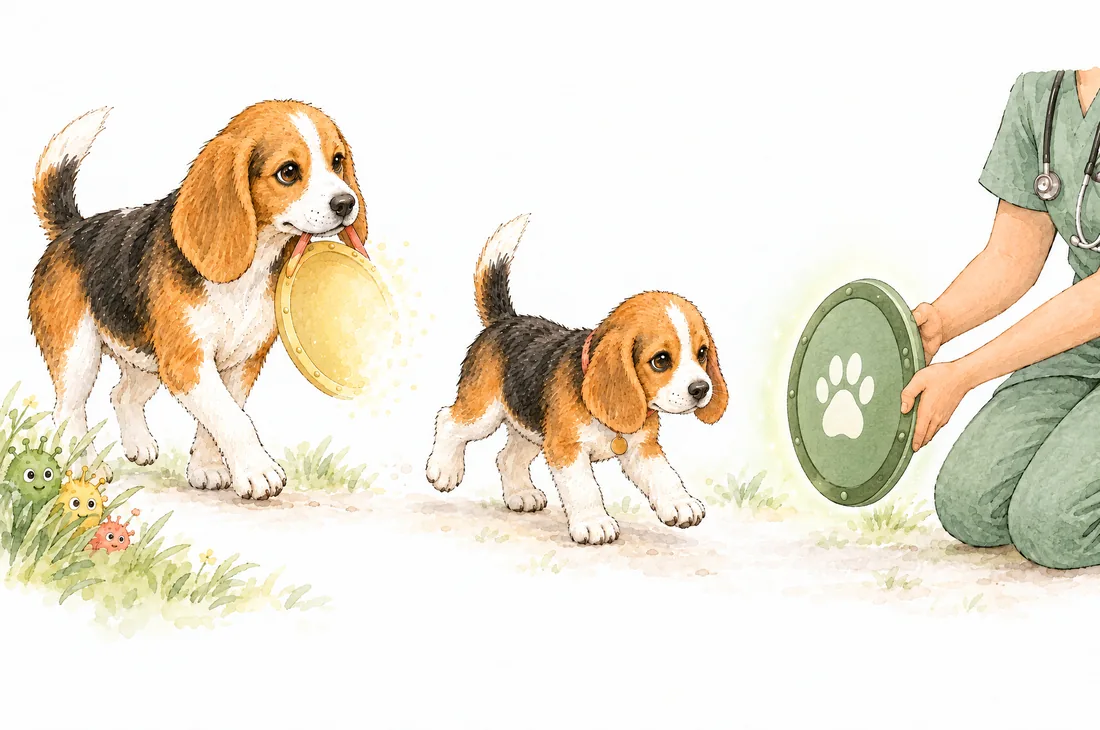
Why so many shots? The Shield Relay
Mom's borrowed shield protects a new puppy but blocks vaccines, and nobody knows the week it fades. That's why the shots come in a series.
Captions are under CC on the player.
Read the transcript
Why does a puppy need so many shots? Meet the Shield Relay. Mom passes her puppy a borrowed shield of antibodies. It protects him early on. But that shield fades at a different week for every puppy, somewhere around 8 to 16 weeks.
And while it's still up, it blocks the vaccine. So each shot is another chance to catch the moment mom's protection drops. That's why shots come every 3 to 4 weeks, until after 16 weeks.
In Texas, rabies is due by 16 weeks. Check your state. Dog parks? Wait 4 or 5 days after the last puppy shot. Lepto is on the AAHA core list. Dr. P decides by lifestyle, breed, size and where you live.
Try it yourself at newpuppy.vet. Your vet's plan comes first.
The puppy vaccine schedule, by age
Five stops, each with its reason. Core shots go to every puppy. The rest depend on where he lives and what he does.
- Core: every puppy
- Lepto: core on paper, ask your vet
- Lifestyle: if his life calls for it
- The line: mom's shield fading, his own shield building
6 to 8 weeks
First puppy shot
- Combination shot #1 (DAPP) (Core: every puppy)
Why: Mom's antibodies are still around and may block it. It's the first chance in the relay, and breeders and shelters often give it before he comes home.
About 11 weeks
3 to 4 weeks later
- Combination shot #2 (Core: every puppy)
Why: Mom's shield fades at a different week for every puppy, and nobody can see when. Each shot is another chance to catch the moment it drops.
12 to 16 weeks
The busy visit
- Combination shot #3 (Core: every puppy)
- Rabies (Core: every puppy)
- Lepto #1, if your vet recommends it (Lepto: core on paper, ask your vet)
Why: Some puppies still carry mom's shield here, so the relay keeps going. Rabies is set by state law: usually 12 to 16 weeks, and in Texas by 16 weeks.
After 16 weeks
The last puppy shot
- Last combination shot (Core: every puppy)
- Lepto #2, if he's getting it (Lepto: core on paper, ask your vet)
Why: By now mom's shield is gone in almost every puppy, so this is the one that matters most. Four or five days later, dog parks, daycare and boarding open up.
About a year later
First boosters
- Combination booster (Core: every puppy)
- Rabies booster (Core: every puppy)
- Lepto, yearly if he gets it (Lepto: core on paper, ask your vet)
Why: The booster backs up any puppy whose series didn't fully take. After it, the combination shot goes every 3 years (AAHA), and rabies follows the vaccine and your state's law.
Lifestyle shots slot in along the way
No fixed stop. Your vet adds them at the regular visits if his life calls for them.
- Kennel cough (Bordetella) (Lifestyle: if his life calls for it)
Most puppies get it, because classes, daycare, grooming and boarding ask for it.
- Canine flu (Lifestyle: if his life calls for it)
Two doses 2 to 4 weeks apart, if daycare or travel calls for it.
- Lyme (Lifestyle: if his life calls for it)
Two doses 2 to 4 weeks apart, where Lyme is common.
A typical example, spaced every 3 to 4 weeks. Every 2 to 4 weeks is within the guidelines, some vets add one more at 18 to 20 weeks where parvo is common, and your vet's plan for your puppy comes first. See it with your puppy's real dates.
See the schedule as a table
| Age | Shots | Why |
|---|---|---|
| 6 to 8 weeks | Combination shot #1 (DAPP) | Mom's antibodies are still around and may block it. It's the first chance in the relay, and breeders and shelters often give it before he comes home. |
| About 11 weeks | Combination shot #2 | Mom's shield fades at a different week for every puppy, and nobody can see when. Each shot is another chance to catch the moment it drops. |
| 12 to 16 weeks | Combination shot #3; Rabies; Lepto #1, if your vet recommends it (ask your vet) | Some puppies still carry mom's shield here, so the relay keeps going. Rabies is set by state law: usually 12 to 16 weeks, and in Texas by 16 weeks. |
| After 16 weeks | Last combination shot; Lepto #2, if he's getting it (ask your vet) | By now mom's shield is gone in almost every puppy, so this is the one that matters most. Four or five days later, dog parks, daycare and boarding open up. |
| About a year later | Combination booster; Rabies booster; Lepto, yearly if he gets it (ask your vet) | The booster backs up any puppy whose series didn't fully take. After it, the combination shot goes every 3 years (AAHA), and rabies follows the vaccine and your state's law. |
| Any visit | Kennel cough (Bordetella) (lifestyle); Canine flu (lifestyle); Lyme (lifestyle) | Added if his life calls for them: classes, daycare, boarding, travel, or where you live. |
The Shield Relay
Slide through your puppy's first 20 weeks. The yellow band is mom's borrowed shield. It's fuzzy on purpose: nobody can see the week it fades for your puppy. Green is his own shield from the vaccine.
- Mom's shield (somewhere in the fuzz)
- His own shield from the vaccine
- Shot that caught on
- Shot that mom's shield blocked
Mom's shield
Mom's borrowed shield is covering him, and it's also blocking any vaccine that shows up.
Shots shown every 3 weeks from 8 weeks, with the last after 16. Every 2 to 4 weeks is within the guidelines, and your vet's schedule comes first.
Core shots and lifestyle shots
Core shots are the ones the guidelines recommend for every dog. Lifestyle shots depend on where your puppy lives and what he does.
Core: every puppy
- Distemper. A virus that hits the lungs, gut and later the nervous system.
- Adenovirus. Causes a liver disease (infectious hepatitis). The A or H in the combination shot.
- Parvovirus. The big one for puppies. Attacks the gut and lives in the ground for months.
- Rabies. Set by law. In Texas, by 16 weeks of age. Check your state's rule.
Leptospirosis: core on paper, a conversation in practice
A bacteria from water and soil that wildlife has peed in. AAHA moved it to its core list in its 2024 update.
Dr. P decides lepto puppy by puppy: lifestyle, breed, size and where you live. A big dog who swims in ponds and hikes is a good candidate. A small dog who lives mostly indoors often skips it. Ask your vet about your puppy's risk.
Lifestyle: depends on his life
- Kennel cough (Bordetella). Most puppies get it, because daycare, boarding, grooming and classes ask for it.
- Canine flu. Only if daycare or travel calls for it.
- Lyme. Rare around Houston. More of a Northeast and Upper Midwest thing.
- Rattlesnake. Worth asking about if you hike or live near brush.
Live somewhere else? Your vet's list will look different, and that's how it's supposed to work. Here's how I set up vaccines for dogs in Cypress.
Rabies usually goes between 12 and 16 weeks. In Texas, the law says by 16 weeks; other states set their own rules. The next one comes a year later.
Shelter, rescue or breeder records: what counts?
Lots of puppies come home with a thin folder, a handwritten card or nothing at all. That's common, it's not your fault, and it's easy to fix.
What the folder usually has
- The date and name of each shot, ideally with the vaccine's sticker or product label
- Deworming dates
- A microchip number
- Rabies, if he was old enough when the shelter had him
- The spay or neuter date, if it's done
Do those shots count?
Shots that are written down with a date and what was given usually count. Your vet looks through the folder and decides what to keep and what to repeat. Shelters and rescues often vaccinate every 2 to 3 weeks because so many dogs are around, and that's a sensible kennel schedule. At home, your vet switches to a home one.
Over 16 weeks: a shorter catch-up
Coming home after 16 weeks with an unfinished series? The catch-up is usually short. Mom's antibodies are almost always gone by then, so the vaccine works right away: AAHA calls for two combination shots, 2 to 4 weeks apart, plus rabies on your state's schedule if there's no record of one.
No records at all
No records, or records nobody can read? Your vet will usually treat him as unvaccinated and start fresh. That's safe: an extra dose in a puppy whose protection is unknown is a small thing next to parvo or distemper. For an older puppy with a partial record, some vets offer a titer, a blood test for distemper and parvo antibodies. Rabies is the exception: a titer doesn't replace the rabies shot.
Bring the whole folder, however thin, and photos of any stickers. Your vet decides what counts.
After the shots: what's normal?
Watch
Normal for the first day
- Sleepy for the rest of the day
- A little sore where the shot went
- Picking at his food
- A mild fever
Call today
Still not himself after one day? Call your vet. Same for a bump at the shot spot that's growing, sore, or still there after about a month.
Go now
- Face or eyes swelling
- Hives
- Vomiting over and over
- Trouble breathing
- Collapse
Head to your vet or the nearest emergency clinic, and call on the way.
What to ask your vet
- Which shots is my puppy getting today, and which are left?
- When is his last puppy shot, and is it after 16 weeks?
- Does my puppy need lepto, given where we live and what he'll do?
- Which lifestyle shots make sense for him: kennel cough, flu, anything else?
- When is rabies due, and what does our state require?
- His records from the breeder or rescue are thin. Which shots count, and what's our catch-up plan?
Questions I get every day
What shots does a puppy need and when?
A combination shot (distemper, parvo and more) every 3 to 4 weeks from the first visit until one dose lands after 16 weeks. Rabies usually at 12 to 16 weeks; Texas requires it by 16 weeks. Lepto is an ask-your-vet shot: two doses 2 to 4 weeks apart, from 12 weeks or later.
Why does the last puppy shot have to be after 16 weeks?
Puppies get antibodies from mom that can block a vaccine from working, and there's no telling exactly when those fade. Repeating the shot until one lands after 16 weeks makes sure it counts.
What is the usual puppy vaccine schedule?
A combination shot (distemper, adenovirus, parvo and usually parainfluenza) every 3 to 4 weeks from about 6 to 8 weeks old, until he's past 16 weeks. Rabies usually goes between 12 and 16 weeks, on your state's timing. Lepto, if your vet recommends it, is two doses 2 to 4 weeks apart from 12 weeks. Boosters come about a year later. Your vet's plan comes first.
How much do puppy shots cost?
It depends on where you live. Prices vary a lot from place to place and year to year, so a national number would be wrong for your town. Your own clinic's prices will be better.
First-year cost plannerDo the shots my puppy got at the shelter or rescue count?
Usually, yes, if they're written down with a date and what was given. Bring the whole folder and your vet decides what counts. A puppy past 16 weeks with an unfinished series usually needs only two catch-up shots, 2 to 4 weeks apart. With no records at all, most vets treat him as unvaccinated and start fresh, which is safe.
Why can't my puppy just get one shot?
Because his mother's antibodies can block a vaccine, and nobody knows the week they fade for any one puppy. Each shot in the series is another chance to catch the moment her protection drops. The last one, given after 16 weeks, is the one that matters most.
My breeder gave shots every 2 weeks. Was that wrong?
No. Every 2 to 4 weeks is within the guidelines, and kennels and rescues often use the tighter end because so many dogs are around. At home, most vets space them 3 to 4 weeks apart. The thing that matters is finishing after 16 weeks.
We missed a booster by a week. Do we start over?
Usually not. Call your vet and get back on track as soon as you can. They'll tell you if he needs an extra dose. What counts is that the series finishes after 16 weeks.
How long after the last puppy shot can he go to the dog park?
Give it four or five days after the last puppy shot before dog parks, daycare or boarding. Daycares, kennels and groomers set their own vaccine rules, and many want kennel cough too, so ask before you book.
Is it normal for my puppy to be sleepy after shots?
Yes. Sleepy, a little sore and picking at his food for a day is normal. If he's still not himself after one day, call your vet. Face swelling, hives, repeated vomiting, trouble breathing or collapse means go now.
A puppy tip from Dr. P every two weeks
One practical tip every two weeks. Just your email.
I won't share your email or sell it. You can get off the list any time. Privacy · Past issues
Where this comes from
- American Animal Hospital Association (AAHA). 2022 Canine Vaccination Guidelines, 2024 update.
- AAHA. Canine Vaccine Guidelines Toolkit (maternal antibodies and vaccine timing).
- World Small Animal Veterinary Association (WSAVA). 2024 Guidelines for the Vaccination of Dogs and Cats; Vaccination FAQ, 2016.
- American College of Veterinary Internal Medicine (ACVIM). Leptospirosis consensus statement, 2023.
- Texas Administrative Code, 25 TAC 169.29 (rabies vaccination by 16 weeks of age).
- Merck Veterinary Manual. Canine distemper; canine parvovirus infection.
General education, not veterinary advice. Your vet's plan for your puppy comes first.