Moose's corner
What's different about raising a giant-breed puppy?
By Dr. Steve Pelton, DVM. Small-animal vet since 2000.
Your host
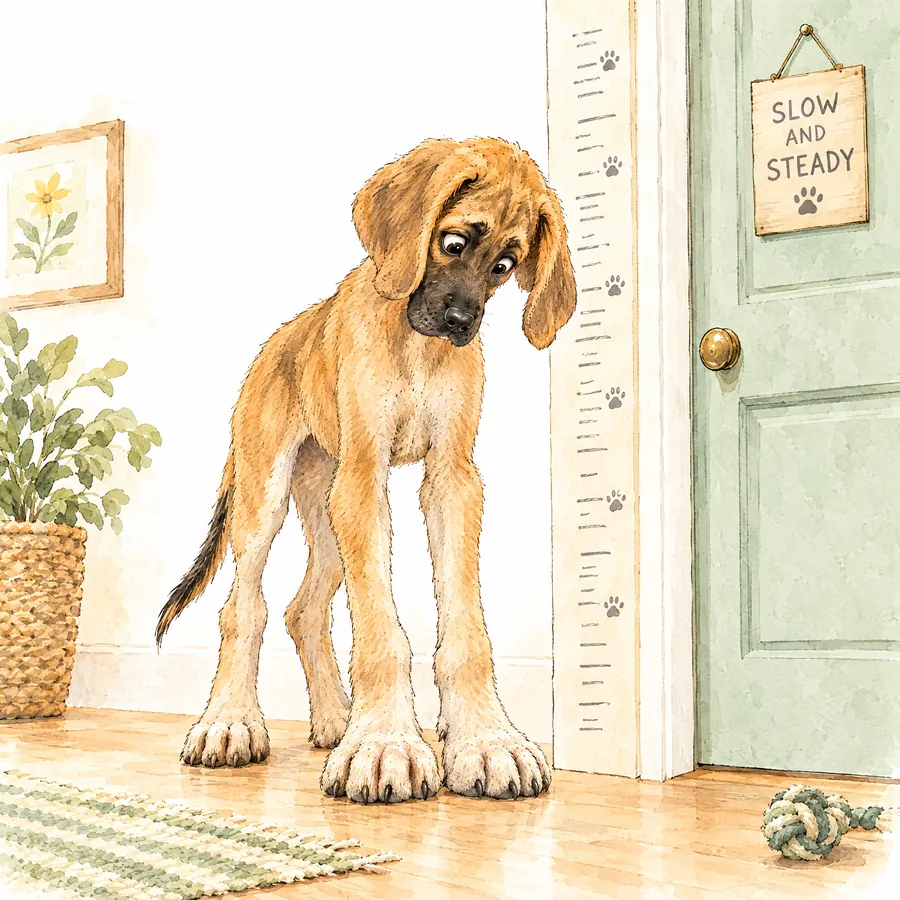
Moose, a Great Dane puppy
This corner is for
Great Danes, Mastiffs, Newfoundlands, big Labs, Goldens, Shepherds, and any mix headed for 70 lb or more.
Mixed breed? Read the corner that fits his body, not just the name on the paperwork. An 80-pound Lab-Shepherd mix belongs in Moose's corner.
The short answer
- Grow him steady, not speedy: large-breed puppy food, and lean enough that you can feel his ribs easily.
- No made-up exercise rules. Soft ground, his own pace, no long pavement runs until he's grown.
- Spay and neuter timing depends on size and sex for big dogs. Talk it through with your vet.
- Learn the signs of bloat by heart. More than 4 in 10 Great Danes will bloat in their lifetime. Any sign means go now.
Slow and steady
Moose will go from fitting in your lap to looking over the kitchen counter in about a year. A big puppy whose weight outruns his joints is more likely to have bone and joint trouble later, so the goal is a steady climb, not a sprint.
- Food: a puppy food labeled "including growth of large size dogs (70 lb. or more as an adult)." No added calcium. More on food.
- Lane and ribs: he should stay in his growth lane and stay lean. Lean beats chunky every time in a giant puppy. Track his growth.
- Gangly phases are normal. All knees and elbows for a while. A limp that lasts more than a day after play is a call.
Bloat: the one to know by heart
Bloat (GDV) is when the stomach fills with gas and twists, trapping the gas and cutting off its own blood supply. It's one of the true emergencies in big, deep-chested dogs, and it can kill in hours. Even with fast surgery, about 1 in 5 dogs don't make it, so minutes matter.
Great Danes are the poster breed. German Shepherds, Standard Poodles, Weimaraners, Irish Setters and Saint Bernards carry real risk too. Ask your vet about your puppy's risk at one of the puppy visits.
Tap what you see
Bloat check: tap any sign you see
Nothing ticked. Keep this page bookmarked, and make sure everyone in the house knows these five signs.
Not sure which one fits? Call your vet. General education, not veterinary advice. Your vet's plan for your puppy comes first.
Questions I get every day
What is bloat in dogs?
Bloat, or GDV, is when the stomach fills with gas and then twists on itself, trapping the gas and pinching off its own blood supply. It can kill in hours, and even with fast surgery about 1 in 5 dogs don't survive. Any sign of it means go now, and call on the way.
How common is bloat in Great Danes?
More than 4 in 10 Great Danes will bloat at some point in their lives, according to a large study of large and giant breeds. Other big, deep-chested breeds carry real risk too, including German Shepherds, Standard Poodles, Weimaraners, Irish Setters and Saint Bernards. Ask your vet about your puppy's risk.
How much exercise can a giant-breed puppy have?
You'll see minutes-per-month-of-age rules online, but there's no good evidence behind them. Let him play on soft ground at his own pace, skip long runs on pavement until he's grown, and ask your vet what fits him. A limp that lasts more than a day is a call.
What should a giant-breed puppy eat?
A puppy food labeled "including growth of large size dogs (70 lb. or more as an adult)." It keeps calcium and calories in a safer range. Don't add calcium, don't switch to adult food early, and keep him lean with ribs you can feel easily.
Where this comes from
- Glickman LT, Glickman NW, Schellenberg DB, Raghavan M, Lee TL. Incidence of and breed-related risk factors for gastric dilatation-volvulus in dogs. JAVMA 2000;216(1):40-45.
- Merck Veterinary Manual. Gastric dilation and volvulus in small animals.
- Association of American Feed Control Officials (AAFCO). Nutritional adequacy statement wording for growth of large size dogs.
- American Animal Hospital Association (AAHA). 2019 Canine Life Stage Guidelines.
General education, not veterinary advice. Your vet's plan for your puppy comes first.