





How long does it take to potty train a puppy?


Quick answer
Most puppies are fairly reliable somewhere around 4 to 6 months old, and some take longer, toy breeds especially. Expect accidents for weeks, plus a few slips later, like after a move or in the teenage months around 6 months.
If you're on your third accident of the morning and wondering whether this puppy will ever get it, you're in good company. Potty training is frustrating at times. It was for me too. I've cleaned puppy pee off a bathroom floor, a rug and a bed, and it wore me down. I held strong, and it worked.
How long does it take to potty train a puppy?
Most puppies are fairly reliable somewhere around 4 to 6 months old, and some take longer. Toy breeds often need extra trips for a little longer, because their bladders are smaller.
The reason it takes months instead of days is plumbing, not attitude. A young puppy's bladder is small and his control is still coming in. He can learn where to go long before his body can always wait to get there. So you'll see him "get it" and still have accidents for weeks.
How often does he need to go out right now?
More than most people expect. While he's awake, it's about every 1 to 2 hours at 8 to 10 weeks, every 2 to 3 hours at 3 months, every 3 to 4 hours at 4 months and every 4 to 6 hours at 6 months.
On top of that clock, take him out first thing in the morning, right after every nap, meal, drink and play session, and right before bed. A full stomach gets his gut moving, and a full bladder is often what woke him up.
There's a rule of thumb you'll hear: his age in months, plus one, is about the most hours he can hold it in the daytime. That's a ceiling, not a target. The Potty Clock on the guide shows it by age.
Why did progress stall now that it's colder?
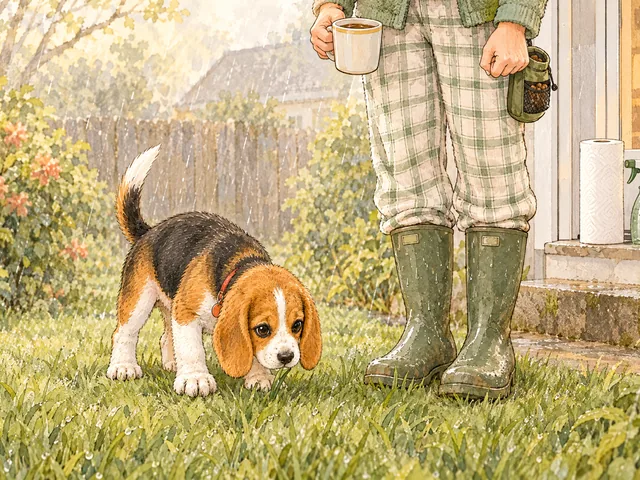
This time of year, I hear this a lot. The days get shorter, the mornings get cooler, a front blows through with rain, and nobody wants to stand in a wet yard at 6 a.m. Trips get skipped or cut short. He didn't forget anything, he just had fewer chances to get it right.
Short trips are a big one. He gets busy sniffing, forgets why he's out there, and pees the minute he's back on the kitchen floor. Stand in his spot quietly for a few minutes, keep him on a leash so he can't wander, and save play for after he goes. If nothing happens, bring him in, keep him in his crate or right next to you for 10 or 15 minutes, and try again.
What setbacks are normal?
It isn't a straight line. A puppy who's been perfect for a week can have three accidents on Saturday. Travel, a move, a new baby or a new job can all bring a slip. Keep the order of his day the same even if the clock is different, and go back to more trips for a week or two.
Then there's the teenage wobble. Somewhere around 6 months, a lot of puppies seem to forget the routine and have an accident for the first time in weeks. Go back to more frequent trips for a couple of weeks and he'll usually come right back.

When you find a puddle later, just clean it up. He can't connect a puddle from ten minutes ago with anything you say now. Blot what you can, then use an enzyme cleaner made for pet accidents so the spot doesn't smell like a bathroom to him. And never punish an accident. Yelling or rubbing his nose in it teaches him to be afraid to pee in front of you, so he sneaks behind the couch instead.
When is it not just training?
A young puppy pees a lot, and most of it is a small bladder and new control. What's not normal is a change, or peeing that looks uncomfortable. A bladder infection is one of the most common reasons a "potty training problem" turns out to be a medical one, and it's easy to check. No amount of patience will house-train a puppy with a bladder infection.
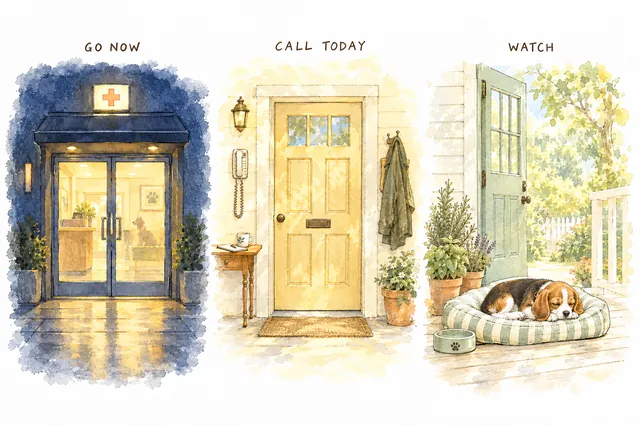
Peeing and accidents: which door?
 WATCH
Lots of peeing after drinking, waking up and play, a little leak when someone exciting walks in, or accidents now and then while he's still learning.
 CALL TODAY
Peeing every few minutes with only a few drops, straining, blood in the urine, dribbling when he's lying down, drinking a lot more water than usual, or accidents after he'd been doing well.
 GO NOW
Straining to pee with nothing at all coming out. He may be blocked. Head to your vet or the nearest emergency clinic, and call on the way.
If you're stuck after a few months of good routine, ask your vet to check his urine, then about a reward-based trainer.
The potty schedule is in the back of The New Puppy. The puppy email comes every two weeks: sign up here.
General education, not veterinary advice. Your vet's plan for your puppy comes first.
Questions owners ask
How long does it take to potty train a puppy?
Most puppies are fairly reliable somewhere around 4 to 6 months old, and some take longer, toy breeds especially. Expect accidents for weeks, plus a few slips later, like after a move or in the teenage months around 6 months.
Why is my puppy having accidents again after doing well?
A move, travel, a new baby or the teenage months around 6 months can all bring a slip. Go back to more frequent trips for a couple of weeks. If accidents come back suddenly, or he's peeing much more than usual, check with your vet before you blame his age, because a bladder infection can look a lot like a teenager.
How often should I take my puppy out to pee?
About every 1 to 2 hours at 8 to 10 weeks, every 2 to 3 hours at 3 months, every 3 to 4 hours at 4 months and every 4 to 6 hours at 6 months, while he's awake. On top of that, take him out first thing in the morning, right after every nap, meal, drink and play session, and right before bed.
General education, not veterinary advice. Your vet's plan for your puppy comes first.